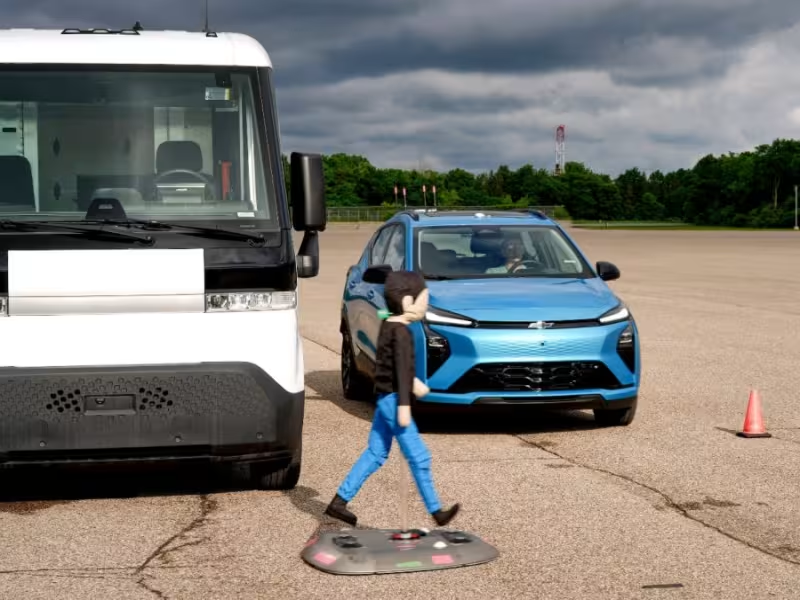
SHERIDAN, WYOMING – June 25, 2026 – As summer driving season shifts into full gear, General Motors is drawing attention to the safety technologies now standard across its most popular family vehicles — from the three-row Chevrolet Traverse to the affordable Chevrolet Trax and the all-electric 2027 Chevrolet Bolt. With the stretch between Memorial Day and Labor Day widely recognized as the most dangerous period on U.S. roads, particularly for teen drivers, GM is highlighting both the breadth of its standard safety features and real-world crash data showing those systems are actually working.
A Safety Legacy That Goes Back Decades
General Motors has been in the crash-testing business longer than most people realize. The company conducted its first crash barrier tests back in 1934, helped develop the first standardized crash test dummies in the early 1970s, and introduced a dummy representing a fifth-percentile female in the 1980s — decades before that kind of occupant diversity became an industry standard. That history shows up in stark terms when you place a 1990 Chevrolet Suburban next to a 2026 Chevrolet Traverse: same brand, radically different levels of protection.
"At GM, product safety is not just a feature. It is a core value embedded in who we are and how we work, and it is built into every stage of vehicle development — from concept and design to deployment and real-world performance," said Regina Carto, vice president of Global Product Safety, Systems and Certification.
What's Standard on Today's GM Family Vehicles
The 2026 Chevrolet Traverse leads with more than 20 standard safety and driver assistance features — a notable number for a three-row family SUV competing in one of the most crowded segments in the market. The 2027 Chevrolet Bolt matches that count and adds a specific suite worth noting: Adaptive Cruise Control, Front Pedestrian Braking, Lane Keep Assist with Lane Departure Warning, Side Bicyclist Alert, Intersection Automatic Emergency Braking, Blind Zone Steering Assist and Rear Cross Traffic Braking — all standard, on an EV starting under $30,000.
The 2026 Chevrolet Trax pushes the affordability argument further. At a starting MSRP of $21,700, it comes with Automatic Emergency Braking, Front Pedestrian Braking, Lane Keep Assist with Lane Departure Warning, Following Distance Indicator, Forward Collision Alert and IntelliBeam as standard kit. That's a meaningful package for a vehicle at that price point.
"We're proud of how we're delivering a set of confidence-building safety features as standard equipment on vehicles that are within reach for more households," Carto said.
The Numbers Behind the Technology
GM commissioned research from the University of Michigan Transportation Research Institute that looked at roughly 12 million GM vehicles from model years 2020 through 2024, cross-referencing them against more than 700,000 police-reported crashes across 18 states. The results are notable. Backing crashes dropped 86%. Rear-end crashes involving injury fell 57%. Front pedestrian crashes with injury were down 35%. Roadway departure crashes decreased 15%, and lane-change crashes dropped 13%.
"The results of this study give us real-world evidence that GM's safety technologies are doing exactly what they're designed to do: helping drivers avoid crashes and reducing injuries in everyday driving environments," Carto said.
These aren't controlled lab numbers — they come from real roads, real drivers, real situations. That distinction matters when evaluating whether the features on a window sticker translate to actual safety.
Safety as Company Culture, Not Just Engineering
Beyond the hardware, GM describes safety as a cultural value running through the organization. The company holds a Global Safety Week, encourages employees to submit concerns through its Speak Up for Safety program, and reportedly starts meetings with safety briefings. In 2025, GM received around 4,700 Speak Up for Safety submissions — a figure the company cites as evidence that safety thinking extends beyond the engineering floor.
The broader approach also includes post-crash considerations: how vehicles are designed to protect occupants after impact, and how the vehicle experience is optimized for first responders. It's a holistic framing that goes beyond the usual pre-crash technology focus.
Mini FAQ
Q: Do all three GM vehicles mentioned offer 20-plus safety features as standard? A: Yes — the 2026 Traverse, 2027 Bolt, and 2026 Trax all include more than 20 standard safety and driver assistance features.
Q: What does the University of Michigan study actually show? A: Researchers examined approximately 12 million GM vehicles and found statistically significant crash reductions across multiple categories, including an 86% drop in backing crashes and a 57% reduction in rear-end crashes with injury.
Q: Is the 2027 Bolt an affordable option given all the safety tech included? A: GM says the 2027 Bolt starts under $30,000, making it one of the more accessible EVs with a full suite of standard driver assistance features.
Q: Does GM's safety work extend beyond the vehicles themselves? A: Yes — GM's safety culture includes employee reporting programs, Global Safety Week events, and ongoing research into crash performance and post-crash outcomes for occupants and first responders.